
There are moments in life that deserve something more than a generic gift pulled from a shelf. A custom printed t-shirt featuring a hand-drawn portrait of your best friend for their 30th birthday. A set of ten matching printed tote bags for your baby shower guests. A personalised hoodie ordered as a single, unique graduation gift for your sibling. A small run of custom printed t-shirts for your family reunion in Dubai this Eid.
These are exactly the situations where DTG printing — Direct-to-Garment — has changed what is possible for individual buyers and small occasion planners across the UAE and دول مجلس التعاون الخليجي.
Until relatively recently, producing a single custom printed garment with a full-colour photographic design required either accepting high minimum order quantities from screen printing facilities, or compromising on print quality through inferior heat transfer methods. DTG printing removed both of those barriers. It brought professional-grade, full-colour garment printing to individual buyers, small families, occasion planners, and anyone who needs between one and fifty personalised pieces — without screen setup costs, without minimum quantity anxiety, and without waiting weeks for production.
In the UAE — one of the region’s most gift-conscious and occasion-driven consumer markets — DTG printing has found an exceptionally strong audience. Whether you are in دبي planning a surprise birthday party, in أبوظبي organising a family Eid gathering, in الشارقة looking for a truly personal wedding gift, or shipping a heartfelt personalised order to a recipient in Saudi Arabia, Qatar, or across Africa — this guide will give you everything you need to understand DTG printing, order with confidence, and get results that genuinely impress.
What Is DTG Printing? A Clear Explanation for Gift Buyers
DTG stands for Direct-to-Garment. The name describes the process accurately — ink is printed directly onto the garment using a specialist inkjet printing system, without screens, without transfers, and without the multi-step setup process that traditional screen printing requires.
Think of a DTG printer as an extremely advanced inkjet printer — similar in concept to the inkjet printer you may have at home, but engineered specifically to print on fabric at commercial quality. The garment is loaded flat onto a platen — a flat printing surface — and the print head moves across the fabric, depositing water-based ink droplets with extreme precision to reproduce your design in full colour.
The result is a printed garment that carries your design with photographic accuracy, soft hand-feel, and colour depth that was previously only achievable through complex multi-colour screen printing setups — but now available for a single piece, or a small run of any quantity.
The DTG Printing Process: Step by Step
Understanding the process helps buyers set realistic expectations and ask the right questions when placing an order.
Step 1 — Artwork Preparation DTG printing accepts digital artwork files directly — typically PNG files with transparent backgrounds, high-resolution JPEGs, or layered PSD files. Unlike screen printing, there is no colour separation process and no limitation on the number of colours in your design. A full-colour photographic image, a complex illustrated portrait, a gradient-heavy artwork, or a design combining Arabic calligraphy with detailed illustration — all are printed in a single pass with no additional cost for colour complexity.
This is one of DTG’s defining advantages for personalised gift buyers: the more complex and colourful your design, the more DTG shines relative to other methods.
Step 2 — Pre-Treatment For printing on dark or coloured garments, a pre-treatment solution is applied to the fabric before printing. This pre-treatment creates a receptive surface that allows the white ink underbase — printed first, beneath your design colours — to achieve full opacity on dark fabric. Pre-treatment is a critical step for dark garment DTG printing. When correctly applied and cured, it is invisible in the finished garment and does not affect wearability or wash performance. When incorrectly applied, it can cause uneven printing, stiffness, or discolouration — one of the quality indicators to assess when choosing a DTG printing supplier.
Step 3 — Printing The pre-treated garment is loaded onto the printer platen and the design is printed. For light garments, colour inks are applied directly. For dark garments, a white ink underbase is printed first, followed immediately by the colour layers on top. Modern commercial DTG printers — including industry-standard systems from brands such as Epson, Brother GTX, Kornit, and Ricoh — complete a full-colour print on a standard t-shirt in two to four minutes.
Step 4 — Curing After printing, the garment passes through a heat press or conveyor dryer to cure the ink. Curing bonds the ink permanently to the fabric fibres. Correct curing temperature and dwell time are critical to wash durability — undercured DTG prints, like undercured screen prints, will wash out prematurely.
Step 5 — Quality Check & Finishing Each printed garment is inspected for colour accuracy, print coverage, and curing quality before folding and packaging. For gift orders, many UAE DTG print suppliers offer gift wrapping, tissue paper presentation, and personalised gift card insertion — services worth confirming when placing your order.
Equipment & Ink Technology: What Makes DTG Possible
The quality of a DTG print is directly determined by the printer hardware and ink system in use. For buyers in the UAE and GCC gifting market, understanding the technology landscape helps identify quality suppliers.
Commercial DTG Printer Systems:
| Brand / System | Market Position | Key Strength |
|---|---|---|
| Epson SureColor F-Series | Industry standard, widely used | Consistent colour, reliable production |
| Brother GTX Series | High-volume commercial | Fast production, wide colour gamut |
| Kornit Atlas / Avalanche | Industrial high-volume | Superior wash durability, inline treatment |
| Ricoh Ri Series | Accessible commercial | Good entry-level commercial quality |
| M&R, Aeoon | Industrial specialist | Maximum volume throughput |
For individual gift buyers and small occasion orders in the UAE, the most important question is not which specific printer brand your supplier uses — it is whether their equipment is properly maintained, correctly calibrated, and operated by trained staff. A well-maintained mid-range DTG system produces significantly better results than a poorly maintained premium system.
DTG Ink Systems: DTG printing uses water-based pigment inks — typically CMYK (cyan, magenta, yellow, black) colour inks plus white ink for underbase printing on dark garments. These inks are:
- Water-based and generally considered skin-friendly for most wearers
- Capable of reproducing virtually unlimited colours in a single print pass
- Formulated to bond with natural and natural-blend fabric fibres — particularly cotton
- Softer and more breathable than plastisol screen printing inks when correctly cured
- Subject to colour performance variation on different fabric compositions — particularly polyester-heavy blends
What Is Possible with DTG Printing for Personalised Gifts
DTG’s capabilities align exceptionally well with the needs of individual gift buyers and small occasion order planners:
Full Photographic Portrait Gifts A high-resolution photograph of a person, a pet, a place, or a moment in time — reproduced faithfully on a premium cotton t-shirt, hoodie, or tote bag. This is one of DTG’s strongest and most distinctive capabilities. For birthday gifts, anniversary gifts, memorial gifts, or pet portrait gifts, DTG delivers a level of photographic detail and emotional resonance that no other garment printing method matches for small quantities.
Unlimited Colour Complexity at No Extra Cost A design with fifty colours costs exactly the same to print as a design with two colours. This is fundamentally different from screen printing, where each additional colour adds screen setup cost. For buyers who want rich, multi-colour artwork — illustrated portraits, watercolour-style designs, gradient-heavy typography, complex Eid or cultural artwork — DTG removes colour as a cost variable entirely.
True Single-Piece Orders One custom printed t-shirt. One personalised hoodie. One unique gift. No minimum quantity. This is DTG’s most commercially significant advantage for individual gift buyers — and one that has no direct equivalent in screen printing.
Small Occasion Run Orders (1–50 pieces) Baby shower favour bags in a run of fifteen. A set of eight matching t-shirts for a bachelorette group. Ten personalised tote bags for a birthday party. Twenty custom printed t-shirts for a family reunion. DTG handles these small-run occasion orders with the same per-unit cost regardless of quantity — making it the natural choice for occasion planners who need small, fully custom runs without the overhead of screen printing setup.
Arabic Typography & Calligraphy Gifts Custom Arabic name prints, Quranic verse gifts, Arabic calligraphy artwork gifts, and bilingual Arabic-English personalised designs are all fully achievable through DTG — with the same colour complexity and photographic accuracy available in English designs. For GCC buyers, this is particularly significant: personalised gifts featuring beautiful Arabic script are among the most meaningful and culturally resonant options available.
Gradient & Watercolour Design Styles Soft gradient backgrounds, watercolour illustration styles, and complex blended colour artwork — popular in the global gifting design market and widely requested by UAE buyers — are reproduced accurately by DTG in ways that screen printing cannot match without significant additional cost and technical complexity.
Personalised Baby & Children’s Gifts DTG’s water-based ink system makes it well-suited for baby and children’s garment printing. Soft hand-feel, breathable finish, and the ability to print detailed illustrated artwork — animals, characters, custom name illustrations — make DTG a strong choice for baby shower gifts, children’s birthday gifts, and personalised baby keepsakes.
What DTG Printing Cannot Do: Important for Buyers to Know
Understanding DTG’s limitations prevents disappointment and helps buyers choose the right method for their specific need:
Performance on Dark Polyester Fabric Is Limited DTG inks bond most effectively with cotton fibres. On high-polyester fabrics — common in sportswear, moisture-wicking fabrics, and some fashion garments — DTG ink adhesion and colour vibrancy are significantly reduced. For dark polyester garments specifically, the white underbase may not achieve full opacity, resulting in muted, less vibrant results. If your gift item is a polyester-dominant garment, discuss this with your supplier before ordering.
Per-Unit Cost Does Not Decrease at Volume Unlike screen printing, DTG has no setup cost but a consistent per-unit production cost at every quantity. For orders above approximately 24–50 pieces of the same design, screen printing typically becomes more cost-effective per unit. DTG is optimised for one to fifty pieces — beyond that, your supplier should advise on whether a hybrid approach or alternative method offers better value.
Not All Garment Colours Achieve Equal Vibrancy DTG on white and very light garments produces the most vivid, accurate colour results — the colour inks are applied directly without underbase. On dark garments, a white ink underbase is required, which adds a layer of process complexity. While modern commercial DTG systems handle dark garments well, results on dark fabrics are generally less vibrant than on white or light substrates — a realistic expectation buyers should carry into the ordering process.
Wash Durability Is Generally Below Screen Printing at Equivalent Quality A properly produced DTG print on cotton is wash-durable and commercially acceptable — typically 20–35 wash cycles before meaningful colour attenuation — but this is lower than the 40–50+ cycles achievable with a properly cured screen print. For gifts intended for very frequent washing — baby clothes, daily-wear workwear, sports uniforms — screen printing or sublimation (on polyester) may offer better long-term durability.
Not Suitable for All Fabric Types DTG works best on 100% cotton and high-cotton blends (80% cotton or above). Nylon, acetate, and very high-polyester blends are generally not compatible with standard DTG ink systems. Always confirm fabric composition compatibility with your supplier before ordering on non-standard substrates.
Exact Pantone Colour Matching Is Not Guaranteed DTG is a CMYK-process print system. It reproduces colour through ink mixing rather than Pantone spot colour. For buyers who need exact brand colour matching — a specific corporate colour reproduced precisely — DTG cannot guarantee the same colour accuracy as Pantone-matched screen printing. For personal gifts where exact colour matching is not a critical requirement, this is generally not a practical concern.
Pros & Cons of DTG Printing for Personalised Gifts & Small Occasion Orders
| Pros | Cons |
|---|---|
| True single-piece orders — no minimums | Per-unit cost does not reduce at high volumes |
| Full photographic quality on fabric | Reduced vibrancy on dark and polyester garments |
| Unlimited colours at no extra cost | Wash durability generally lower than screen printing |
| Ideal for 1–50 piece occasion orders | Not suitable for all fabric types |
| Soft, breathable water-based ink finish | Pre-treatment quality affects dark garment results |
| Perfect for portrait, photo, and illustration gifts | Exact Pantone colour matching not guaranteed |
| Arabic typography and complex designs fully supported | Equipment maintenance directly affects output quality |
| Fast turnaround — no screen setup time | Higher per-unit cost than screen printing at volume |
| Ideal for last-minute gift orders | White underbase can feel slightly heavier on dark garments |
| Wide creative freedom for gift designers | Colour variation between print runs possible |
Why DTG Is the Right Choice for GCC Gift Buyers & Occasion Planners
The GCC gifting market has characteristics that align particularly well with DTG printing’s strengths:
Occasion diversity is high. The UAE calendar is dense with gifting occasions — Eid Al Fitr, Eid Al Adha, UAE National Day, Saudi National Day, graduations, weddings, baby showers, birthdays, Valentine’s Day, Mother’s Day, and more. Each occasion generates demand for personalised, occasion-specific designs that change with every event. DTG’s no-setup, any-design flexibility serves this occasion variety better than any fixed-setup method.
Gift buyers in الإمارات and السعودية increasingly value uniqueness. The regional consumer market has matured significantly. Buyers in دبي, أبوظبي, and الرياض are moving decisively away from generic retail gifts toward personalised, made-to-order alternatives. DTG enables the kind of truly unique, single-piece custom gift that this market increasingly demands.
Small family and friend group occasion orders are culturally central. Matching family Eid outfits for five family members. Eight personalised bags for a bridal party. Twelve custom t-shirts for a cousins’ trip. These small occasion runs — too small for economical screen printing, too large to order individually from premium gift retailers — are DTG’s natural territory.
Arabic design capability matters. For buyers across دول مجلس التعاون الخليجي, the ability to incorporate authentic Arabic calligraphy, bilingual name prints, and culturally resonant Arabic artwork into personalised gifts is non-negotiable. DTG reproduces Arabic typography with the same fidelity as any other artwork, making it a genuinely inclusive solution for the GCC personalised gifting market.
Performance may vary depending on substrate, ink system, finishing, and environmental exposure.
Climate Durability in GCC & African Conditions
DTG Printed Personalised Gifts & Small Occasion Orders
Will My DTG Printed Gift Last? Climate Durability in the UAE, GCC & Africa
For gift buyers and occasion planners in the Gulf region, durability is not a minor consideration — it is central to the value of the gift itself. A personalised DTG printed t-shirt that cracks, fades, or washes out within a month is not a meaningful gift — it is a disappointment. Understanding how DTG prints perform under the specific environmental conditions of the UAE, GCC, and Africa allows you to make informed decisions, specify correctly, and ensure the gifts you give endure long after the occasion has passed.
DTG printing has its own distinct durability profile compared to screen printing — and in the context of GCC climate conditions, several factors require specific attention that buyers ordering from temperate-climate markets would never need to consider.
Heat Exposure: DTG Prints in 40–55°C Gulf Environments
The Arabian Gulf summer is among the most thermally demanding environments on earth for printed textiles. Surface temperatures inside vehicles parked in direct sun in دبي and الرياض regularly exceed 70–80°C. Outdoor fabric surfaces under direct solar exposure can reach comparable temperatures. How does a DTG printed gift perform under these conditions?
The curing factor is critical for DTG. DTG inks are water-based pigment inks cured through a heat press or conveyor dryer at typically 160–165°C for a defined dwell time. When this curing process is correctly executed, the ink bonds permanently with the cotton fabric fibres and achieves its rated wash and heat stability. When curing is insufficient — a more common production fault in DTG than in screen printing due to the additional variable of pre-treatment moisture content affecting heat transfer — the ink film has not fully bonded and will degrade rapidly under both heat and washing.
For gift buyers, this means: The difference between a DTG print that lasts two years and one that fails after three washes is almost entirely determined by the quality control of your chosen print supplier — not by DTG printing as a method. A reputable supplier with calibrated heat press equipment, trained operators, and wash-testing protocols will produce heat-stable, durable DTG prints. A budget supplier cutting corners on curing time or pre-treatment quality will not.
Practical heat stability of correctly produced DTG prints: Under normal GCC ambient conditions — air-conditioned interiors, standard outdoor temperature exposure during wearing, transport in cooled vehicles — a correctly cured DTG print on 100% cotton performs well and does not degrade from ambient heat alone. The concern is not everyday wear in hot weather; it is storage and transport in uncooled conditions (vehicle interiors, outdoor storage areas, shipping in non-temperature-controlled containers) where sustained extreme heat exposure over hours can stress the ink-fabric bond in borderline-cured prints.
Recommendation for GCC gift buyers: For gifts that will be transported or stored in potentially hot conditions — particularly during UAE summer months — confirm with your DTG supplier that they conduct heat press calibration checks and wash-test production samples. Request that finished gifts be packaged in breathable materials rather than sealed heat-retaining packaging for summer delivery and storage.
UV Radiation & DTG Prints: Colour Fading Under Gulf Sun
UV radiation in the Arabian Peninsula reaches extreme levels — UV Index 10–12 is routine during summer months across the UAE, Saudi Arabia, Qatar, and Kuwait. This has direct implications for DTG ink colour stability under prolonged outdoor exposure.
How DTG inks respond to UV exposure: DTG water-based pigment inks contain organic pigments that are moderately UV-stable under normal wearing conditions — comparable in general terms to screen printing inks of similar quality grade. However, there are important nuances for GCC buyers:
White ink underbase and UV exposure: On dark garments, the white ink underbase printed beneath colour layers is a defining factor in dark-garment DTG durability. Under sustained UV exposure, the white underbase can yellow or discolour over time — causing the colour layers above it to appear less vibrant or shifted in tone. This is a known characteristic of DTG on dark garments and is accelerated by intense UV exposure such as that experienced across the Gulf region.
Colour-specific UV vulnerability in DTG:
- Reds and magentas — moderate UV stability, can shift toward orange-pink tones under prolonged sun exposure
- Blues and cyans — generally good UV stability in quality pigment inks
- Yellows — more vulnerable to UV-driven fading, particularly on light garments
- Black — most UV-stable colour in DTG printing
- White ink layers — vulnerable to yellowing under sustained UV and heat combined
What significantly extends DTG colour life under GCC UV conditions:
Washing printed garments inside-out is the single most impactful step a recipient can take — it reduces direct UV exposure on the print surface during outdoor drying, which is one of the highest UV-exposure moments in a garment’s lifecycle. Additional steps include drying in shade rather than direct sunlight and storing garments away from sun-facing windows.
When UV printing is preferable to DTG for gift applications: For personalised gifts intended for continuous outdoor display — a custom printed banner, an outdoor-facing decorative item, or any rigid printed gift item — UV-curable printing systems offer meaningfully superior UV resistance compared to DTG water-based inks. DTG is optimised for wearable garments used and washed regularly, not for continuous static outdoor UV exposure.
Recommendation for GCC occasion planners: For outdoor event T-shirts — family reunion gatherings, outdoor Eid celebrations, National Day events — include care instruction cards with gifts specifying inside-out washing and shade drying. This simple addition meaningfully extends print vibrancy and demonstrates thoughtfulness as part of the gift presentation.
Wash Durability in Hot Climates: The Most Important Durability Factor for DTG Gifts
Wash durability is the single most practically important durability dimension for wearable DTG gifts in the GCC market. The Gulf climate drives more frequent garment washing than most global markets — perspiration in high heat, combined with cultural emphasis on cleanliness, means garments are washed more regularly than in cooler climates. Understanding realistic DTG wash durability expectations prevents disappointment and helps buyers choose the right method for each gift application.
Realistic DTG wash durability benchmarks:
| Garment Type | Ink System | Care Practice | Expected Wash Durability |
|---|---|---|---|
| 100% cotton, light garment, correctly cured | Standard DTG pigment | Cold wash, inside-out, air dry | 25–40 wash cycles |
| 100% cotton, dark garment, correctly cured | DTG pigment + white underbase | Cold wash, inside-out, air dry | 20–35 wash cycles |
| 80/20 cotton-polyester blend, light | Standard DTG pigment | Cold wash, inside-out, air dry | 20–30 wash cycles |
| 100% cotton, any colour, correctly cured | Premium DTG pigment (Kornit) | Cold wash, inside-out, air dry | 30–50 wash cycles |
| Any garment, undercured | Any | Any | 3–10 wash cycles — unacceptable |
Performance may vary depending on substrate, ink system, finishing, and environmental exposure.
The hot water washing risk in GCC climates: Many households across the UAE and Gulf region wash garments at higher temperatures than the 30–40°C recommended for printed textiles. Hot water washing — particularly at 60°C+ — significantly accelerates ink degradation in DTG prints. Including a simple care instruction card with personalised DTG gifts is not merely a nice touch — in the GCC climate and laundry culture context, it is a meaningful contribution to the longevity of the gift.
DTG vs screen printing wash durability — a clear-eyed comparison for GCC buyers: Screen printing with fully cured plastisol inks outperforms DTG on raw wash durability — 40–50+ cycles versus 20–40 for DTG on comparable garments. However, this comparison must be contextualised: for the majority of personalised gift use cases — a birthday t-shirt worn weekly, a family Eid outfit worn a handful of times per year, a baby shower tote bag used regularly — DTG’s wash durability is entirely fit for purpose. The durability gap becomes relevant only for high-frequency daily-wear items washed very frequently in hot conditions.
Humidity & Coastal Conditions: DTG Gifts in Dubai, Doha, Bahrain & Muscat
Coastal GCC cities — دبي, الدوحة, المنامة, مسقط — experience sustained high relative humidity, regularly reaching 80–90% during summer months combined with salt-laden marine air. How does this affect DTG printed gifts?
Pre-treatment and humidity — a specific DTG concern: The pre-treatment solution applied to dark garments before DTG printing is water-based. In high-humidity production environments, pre-treatment drying time and moisture content at the point of printing are critical variables. Excess moisture in the pre-treated garment at print time can cause ink spreading, colour inaccuracy, and reduced adhesion — a production quality risk specific to DTG that is heightened in humid environments.
Reputable DTG print suppliers in the UAE manage this through climate-controlled production spaces and pre-treatment drying protocols. It is a production process consideration rather than a consumer concern — but it explains why humidity can affect DTG print quality at low-quality or uncontrolled production facilities.
For stored and gifted DTG items in coastal GCC cities: Properly cured DTG prints on fabric are not damaged by ambient coastal humidity under normal storage and wearing conditions. The same guidance applies as for screen printed gifts — store in breathable packaging, avoid damp storage conditions, and ensure garments are fully dry before folding and storing.
Sand & Dust Abrasion: DTG Gifts for Active & Outdoor Lifestyles
Sand and dust abrasion is a relevant consideration for personalised gifts given to recipients with active outdoor lifestyles in the GCC interior — hikers, outdoor sports participants, construction workers, and field professionals in Saudi Arabia, Kuwait, UAE desert regions, and Oman.
DTG print abrasion resistance: Correctly cured DTG prints on cotton have reasonable surface abrasion resistance for normal garment use. The water-based pigment ink penetrates fabric fibres rather than sitting entirely on the surface — which gives it a degree of inherent abrasion resistance compared to surface-deposited coatings.
However, DTG prints are generally considered less abrasion-resistant than fully cured plastisol screen prints, which form a more robust surface film. For personalised gifts intended for genuinely demanding outdoor use — construction site workwear, field work garments, active outdoor sports — screen printing is the more durable choice. For lifestyle-oriented outdoor gifts such as personalised hiking t-shirts or casual outdoor occasion wear, DTG performs acceptably.
Fabric Breathability: DTG Gifts for Wearable Comfort in GCC Heat
This is an area where DTG printing holds a genuine advantage over screen printing for wearable gifts in hot climates. DTG water-based inks penetrate fabric fibres rather than sitting on top of the fabric surface as a film layer — the printing mechanism of plastisol screen printing. The result is a printed garment with meaningfully better breathability and a softer, more natural hand-feel.
For GCC occasion planners and gift buyers specifying wearable gifts: DTG-printed garments are more comfortable to wear in high temperatures than heavily screen-printed equivalents — particularly for designs with large coverage areas. A custom printed family reunion t-shirt with a large back print in DTG will feel noticeably lighter and more breathable in 40°C+ outdoor conditions than the same design printed in thick plastisol.
This breathability advantage makes DTG particularly well-suited for:
- Eid family gathering outfits worn outdoors
- National Day celebration t-shirts
- Summer birthday party personalised gifts
- Baby and children’s personalised garments in the Gulf climate
- Any occasion where the gift will be worn in warm outdoor conditions
DTG Prints on Dark vs Light Garments in GCC Conditions: Durability Summary
This distinction is particularly important for GCC buyers, where navy, black, and dark colours dominate corporate and occasion garment preferences:
| Factor | Light Garments (White / Pale) | Dark Garments (Navy / Black) |
|---|---|---|
| Colour vibrancy | Excellent — direct ink on fabric | Good — dependent on white underbase quality |
| UV fade risk | Moderate — yellows most vulnerable | Higher — white underbase can yellow under sustained UV |
| Wash durability | 25–40 cycles correctly cured | 20–35 cycles correctly cured |
| Heat stability | Good — correctly cured | Good — correctly cured, slightly more variable |
| Recommended care | Cold wash, inside-out, shade dry | Cold wash, inside-out, shade dry — more important |
| Best for GCC occasions | Summer events, baby gifts, light casual wear | Formal gatherings, evening occasions, Eid sets |
African Climate Considerations for DTG Printed Gifts
For buyers shipping DTG printed personalised gifts to recipients in Africa — whether in East Africa, West Africa, North Africa, or Madagascar — several climate-specific factors apply:
Equatorial heat and humidity in countries including Kenya, Nigeria, Ghana, Côte d’Ivoire, Cameroon, and Madagascar presents conditions comparable to or exceeding Gulf summer humidity levels. Pre-treatment moisture management and curing quality in production are equally critical for DTG gifts destined for these markets.
UV intensity across sub-Saharan and equatorial Africa is comparable to GCC UV levels — the same inside-out washing and shade drying care guidance is relevant and worth including with gifts shipped to African recipients.
Shipping conditions from UAE print hubs — the primary production base for pan-African gifting orders consolidated through الشارقة and دبي — may involve extended transit times and variable temperature and humidity control. Correctly cured DTG prints on 100% cotton are sufficiently stable to withstand normal shipping conditions, but breathable packaging and sealed polybags to prevent moisture ingress during transit are recommended for Africa-bound gift shipments.
GCC Gifting Occasions & DTG Durability: Practical Decision Guide
| Occasion | Garment Type | DTG Suitable? | Key Durability Note |
|---|---|---|---|
| Eid family matching outfits | Cotton t-shirts / thobes | Yes — excellent | Cold wash care, inside-out, shade dry |
| Birthday photo portrait gift | Premium cotton tee | Yes — ideal use case | Single piece, full photo detail |
| Baby shower favour bags | Cotton tote bags | Yes | Water-based inks, soft finish |
| Wedding party gift set | Cotton tote / t-shirt | Yes — up to 30 pieces | Consistent colour across run |
| Graduation gift hoodie | Cotton-blend hoodie | Yes | Confirm cotton content above 80% |
| National Day outdoor event tees | Cotton t-shirts | Yes — with care card | Include inside-out wash instructions |
| Outdoor sports / active use gift | Polyester sportswear | Not recommended | Use sublimation for polyester |
| Daily workwear uniform | Cotton work shirt | Marginal — consider screen print | Screen print better for daily heavy wash |
| Children’s party favour bags | Cotton tote bags | Yes — excellent | Water-based inks ideal for children’s items |
| Memorial / keepsake photo gift | Premium cotton tee | Yes — ideal use case | Archive quality — store away from sun |
DTG Printing in Practice: Gifting Occasions, Comparisons, Buyer Mistakes & Expert Recommendations for UAE & GCC Buyers
Ideal Gifting Occasions & Small Occasion Orders for DTG Printing in the UAE & GCC
DTG printing’s defining strengths — no minimum quantities, full photographic colour, fast turnaround, and complete design freedom — align with a specific and growing segment of the GCC gifting market. The following occasions represent the highest-value, highest-demand applications for DTG printed personalised gifts and small occasion orders across الإمارات, دول مجلس التعاون الخليجي, and Africa.
Birthday Gifts: The Single-Piece Photo Gift Opportunity
Birthday gifting is the single largest demand category for DTG printing among individual buyers in the UAE. The reason is straightforward: DTG is the only garment printing method that can produce a single, fully personalised, photographic-quality gift at a reasonable per-unit cost — and birthdays are the occasion where a truly unique, one-of-a-kind gift carries the most emotional impact.
Most popular DTG birthday gift formats:
- Photo portrait t-shirts — a high-resolution portrait of the birthday person, a beloved pet, or a meaningful place, printed in full colour on a premium cotton tee. This is DTG’s flagship gift product and one of the most searched personalised gift types in دبي and across the UAE.
- Illustrated name gifts — custom illustrated typography featuring the recipient’s name, age, and personalised design elements
- Memory collage t-shirts — a collage of photographs from a friendship, relationship, or family history, printed across the front or back of a garment
- Inside joke and custom artwork gifts — original illustrated artwork, humorous custom designs, or deeply personal imagery that has meaning only to the giver and recipient
For milestone birthdays — 18th, 21st, 30th, 40th, 50th — the demand for genuinely special, one-of-a-kind gifts is highest, and DTG’s ability to produce a single photographic masterpiece on a premium garment makes it the strongest available option in the personalised gifting market.
Baby Shower & New Baby Gifts: The Softest, Most Personal Option
DTG printing is arguably the best available method for personalised baby and newborn gifts in the GCC market. Water-based DTG inks produce a soft, skin-friendly finish that is comfortable against delicate baby skin — a critical consideration in the warm Gulf climate. The ability to print detailed illustrated artwork — custom name illustrations, animal characters, whimsical birth announcement designs — in full colour on a single onesie or baby t-shirt makes DTG uniquely capable in this category.
Popular DTG baby gift formats:
- Personalised baby onesies with illustrated name designs
- Custom birth announcement t-shirts featuring name, birth date, weight, and height
- Illustrated animal character gifts personalised with the baby’s name
- Matching sibling gift sets — a new baby onesie paired with a big sibling t-shirt
- Personalised baby tote bags for hospital visits or baby shower gifts
For buyers in الإمارات and السعودية gifting for new babies, DTG’s ability to incorporate both Arabic and English name typography in a single design is a particularly meaningful capability — personalised bilingual name gifts are among the most requested and most loved baby gift formats in the GCC market.
Wedding & Bridal Party Gift Sets: Small Runs, Maximum Personalisation
Weddings in the GCC are elaborate, multi-day celebrations with large guest lists and significant gifting traditions. DTG printing serves the wedding gifting occasion in a specific and valuable way — small, highly personalised gift sets for the bridal party, the couple, and close family members where design complexity and personalisation depth matter more than per-unit cost efficiency.
DTG wedding gift applications:
- Bridal party gift bags — personalised tote bags for bridesmaids, each featuring their individual name alongside shared wedding artwork, in runs of four to twelve pieces
- Couple portrait gifts — a custom illustrated or photographic portrait of the couple printed on a premium cotton canvas bag, cushion cover, or t-shirt as a wedding gift
- Wedding date keepsake t-shirts — personalised with the couple’s names, wedding date, and custom artwork as a gift for close family
- Honeymoon gift sets — matching personalised t-shirts or tote bags for the newlywed couple, featuring destination artwork or couple-specific design
- Flower girl and page boy personalised gifts — custom printed t-shirts or tote bags for younger members of the wedding party
The key advantage DTG offers in the wedding gifting context is design freedom — the ability to incorporate photographs, complex illustrated artwork, gradient designs, and multi-colour typography that would be cost-prohibitive in screen printing for small quantities.
Eid Gifts & Family Occasion Orders: Small Runs for Big Moments
Eid Al Fitr and Eid Al Adha represent the two most culturally significant gifting and occasion ordering moments in the GCC calendar. For DTG printing, Eid occasions generate demand for small family matching sets — typically between four and fifteen pieces — where full-colour Arabic calligraphy, family name prints in Arabic and English, and culturally resonant illustrated artwork are required.
DTG handles these small Eid family sets exceptionally well:
- Full-colour Arabic calligraphy and name prints in a single pass
- Bilingual Arabic-English family name designs
- Complex illustrated Eid artwork with gradient backgrounds and multi-colour elements
- Sizes from infant to adult in a single order run
- No minimum quantity — a family of four can order exactly four pieces
For occasion planners organising small Eid gatherings — extended family get-togethers, friends’ group Eid celebrations, or community event shirts — DTG’s flexibility across quantities from one to fifty pieces makes it the most accessible and most creatively versatile option available.
Graduation Gift Orders: The Perfect One-Off Commemorative Gift
Graduation season in the UAE — running from approximately May through July — generates consistent demand for personalised DTG printed gifts. A single custom hoodie for a graduating sibling. A set of eight matching t-shirts for a group of university friends celebrating together. A personalised photo portrait gift capturing a graduate’s proudest achievement.
DTG’s strength in the graduation gifting category is its ability to combine photographic portrait quality with personalised text — graduate name, degree, institution, graduation year — in a single full-colour print on a premium garment. No other method delivers this combination at small quantities with comparable quality.
Farewell, Memory & Keepsake Gifts: DTG’s Most Emotionally Resonant Category
One of DTG printing’s most meaningful and underserved gift categories in the GCC market is the farewell and memory gift. The UAE’s expatriate-majority population creates constant demand for this category — colleagues relocating after years together, friends leaving Dubai for new chapters, teachers saying goodbye to students, sports teams marking the end of a season.
A custom DTG printed t-shirt or tote bag featuring a group photograph, a memory collage, or a meaningful illustrated design is among the most emotionally impactful personalised gifts available — and DTG’s photographic quality capability makes it uniquely suited to this occasion. For buyers in دبي’s large expatriate community, this is a deeply relevant and frequently needed gift category.
Comparison With Other Personalised Gift Methods
Understanding precisely where DTG sits relative to competing methods helps buyers make confident, well-informed decisions.
| Method | Best Quantity | Colour Capability | Photo Quality | Per-Unit Cost | Best Gift Use Case |
|---|---|---|---|---|---|
| DTG Printing | 1–50 pieces | Unlimited, full colour | Excellent | Moderate — consistent at any quantity | Photo gifts, complex artwork, single pieces |
| Screen Printing | 24–500+ pieces | Spot colour, Pantone | Limited halftone | Low at volume, high setup for small runs | Bold colour sets, family matching, large runs |
| Embroidery | 6–500+ pieces | Limited thread colours | Not applicable | Moderate — premium feel | Caps, polos, premium fabric gifts |
| Sublimation | 1–100+ pieces | Unlimited, photographic | Excellent | Low-moderate | White/light polyester gifts, all-over prints |
| Heat Transfer Vinyl | 1–24 pieces | Limited solid colours | Not applicable | Low | Simple name/number personalisation |
| Laser Engraving | 1–500+ pieces | None — material only | Not applicable | Moderate | Hard gifts — metal, wood, acrylic |
| UV Printing | 1–500+ pieces | Full colour | Excellent | Moderate | Rigid gift items, phone cases, acrylic |
The practical decision framework for GCC gift buyers:
Choose DTG when you need one to fifty pieces, full photographic colour, complex artwork, or a single truly unique gift. Choose screen printing when you need fifty or more pieces of bold, vibrant colour on cotton with maximum wash durability. Choose sublimation when your gift item is white or light polyester and you want all-over photographic coverage. Choose embroidery when you want a premium, tactile, long-lasting finish on caps, polos, or quality fabric items.
Common Buyer Mistakes When Ordering DTG Printed Gifts
These are the errors most frequently responsible for disappointing DTG gift outcomes — all entirely avoidable with the right knowledge.
Mistake 1: Choosing a Supplier Based on Price Alone
DTG print quality is more variable between suppliers than almost any other print method. The difference between a correctly cured, properly pre-treated, colour-calibrated DTG print and a poorly produced one is dramatic — and the price difference between quality and budget suppliers in the UAE market can be as little as a few dirhams per piece. For a personalised gift — where the emotional investment is high and the occasion is specific — choosing the cheapest available option without verifying quality is the single most common and most costly mistake buyers make.
What to do instead: Request physical samples of previous DTG work from the supplier. Look specifically at dark garment prints — these reveal pre-treatment and underbase quality more clearly than light garment prints. Check that colours are vibrant, edges are crisp, and the print feels soft rather than stiff or plasticky.
Mistake 2: Supplying Low-Resolution or Incorrectly Formatted Artwork
DTG printing reproduces your artwork at the resolution and quality you provide. A photograph taken on a smartphone and sent via WhatsApp — heavily compressed, reduced in resolution — will print with visible pixelation and colour inaccuracy. A design downloaded from social media as a small JPEG will produce a blurred, unprofessional result regardless of the printer’s capabilities.
What to do instead: Supply artwork at a minimum of 300 DPI at the intended print size. For photographic portrait gifts, provide the highest-resolution original photograph available — taken on a modern smartphone camera in good lighting, this is typically sufficient. For illustrated or typographic designs, supply as PNG with transparent background or as a vector file. If you are unsure, ask your supplier’s design team — most reputable DTG suppliers in دبي and الشارقة offer artwork preparation and optimisation services.
Mistake 3: Not Confirming Fabric Composition Before Ordering
DTG inks bond most effectively with cotton. Ordering DTG printing on a garment without confirming its fabric composition is a risk that frequently results in poor colour vibrancy, reduced wash durability, or ink adhesion failure on polyester-heavy substrates. This mistake is particularly common when buyers source their own blank garments and bring them to a DTG supplier for printing.
What to do instead: Always confirm fabric composition with your supplier before ordering. For the best DTG results, specify 100% cotton or minimum 80% cotton blend garments. If the gift item is inherently polyester — a sportswear garment, a moisture-wicking fabric — discuss sublimation printing as the appropriate alternative.
Mistake 4: Expecting DTG to Match Screen Print Wash Durability
DTG and screen printing have different wash durability profiles. Buyers who expect DTG printed gifts to perform identically to screen printed garments over fifty or more heavy-wash cycles will be disappointed — not because DTG has failed, but because they have applied the wrong benchmark. DTG is optimised for personalised gifts and small occasion orders where design quality, colour complexity, and quantity flexibility matter most. For high-frequency daily-wash applications, screen printing is the more durable choice.
What to do instead: Match the method to the intended use. For a birthday photo portrait t-shirt worn weekly and washed regularly — DTG is appropriate and fit for purpose. For a daily-wear uniform washed in hot water five times a week — screen printing or an alternative method is the correct specification.
Mistake 5: Ordering at the Last Minute for Major GCC Occasions
DTG printing is faster than screen printing — there is no screen setup, no colour mixing, and no registration process. A single DTG print can theoretically be produced in minutes. However, this does not mean same-day or next-day delivery is always available, particularly during peak gifting seasons in the UAE.
During Eid, UAE National Day, graduation season, and Valentine’s Day — the UAE’s highest-volume gifting periods — reputable DTG suppliers are operating at or near full capacity. Last-minute orders during these periods face either unavailability or rushed production that compromises quality.
What to do instead: For Eid and National Day gifts, order a minimum of two weeks in advance. For birthdays and smaller occasions, five to seven working days is a comfortable lead time for standard DTG orders. For same-day or next-day requirements, confirm availability explicitly with your supplier before assuming it is possible.
Mistake 6: Ignoring Care Instructions With the Gift
A DTG printed gift without care instructions is an incomplete gift in the GCC context. The Gulf climate’s high temperatures, frequent washing habits, and hot water laundry practices are among the most demanding conditions for DTG print longevity. A simple care card included with the gift — cold wash, inside-out, no bleach, air dry in shade — can meaningfully extend the life of the print and demonstrates genuine thoughtfulness as part of the gift presentation.
What to do instead: Ask your DTG supplier whether they include printed care instruction cards with gift orders. If not, prepare a simple card to include yourself. Frame it as part of the gift — not as a warning, but as guidance for preserving something made specifically for the recipient.
Expert Recommendation: How to Order the Perfect DTG Printed Gift in the UAE
1. Define your design clearly before approaching a supplier. The more complete your design brief — reference images, colour preferences, text content, placement on garment — the more accurately your supplier can advise on feasibility, file requirements, and expected output quality.
2. Choose the garment before the design, not after. The garment is as much a part of the gift as the print. A premium 200gsm 100% cotton t-shirt feels and communicates quality in a way that a 140gsm economy blank does not. Select a garment weight, colour, and composition appropriate to the occasion and the recipient before finalising your design.
3. For photographic gifts, invest in image quality. Take or source the highest-resolution photograph available for portrait gifts. Photograph subjects in good natural light, against a clean background if possible, and supply the original uncompressed file to your supplier. Image quality is the single most controllable variable in the quality of a photographic DTG gift.
4. Request a digital proof and review it carefully. Before production is confirmed, review your digital proof on a calibrated screen — not on a smartphone with variable display settings. Check colour, text accuracy including any Arabic script, design placement, and proportions relative to the garment size. A careful proof review costs nothing and prevents expensive reprinting.
5. Include a care card and quality presentation packaging. A well-presented gift speaks before it is even touched. Tissue paper, a simple gift box, a personalised gift tag, and a care instruction card transform a printed garment from a product into a proper gift. Confirm whether your supplier offers gift packaging — many UAE DTG suppliers do, and it is worth the small additional cost for occasion gifts.
6. Plan your timeline around the occasion, not around convenience. Order with the occasion date as your fixed point and work backwards — allowing production time, delivery time, and a buffer for any corrections. A gift that arrives two days after the birthday is not the same gift as one presented on the day.
Personalised DTG Printing in UAE
DTG printing has opened personalised gifting to a level of creative freedom, individual expression, and small-quantity flexibility that was simply not commercially accessible a decade ago. For individual buyers across the UAE and GCC looking for a truly unique birthday gift, a heartfelt wedding present, a meaningful baby shower keepsake, a small family Eid matching set, or a farewell gift that genuinely captures a shared history — DTG printing delivers what no retail shelf ever could.
The key is approaching the process with the right knowledge: choose a quality-controlled supplier, supply the best artwork you have, specify the right fabric, plan your timeline generously, and present the finished gift with the care it deserves. Do all of that, and DTG printing will produce something the recipient will genuinely treasure.
For personalised DTG printed gifts and small occasion orders delivered across دبي, أبوظبي, الشارقة, and shipped regionally across دول مجلس التعاون الخليجي and Africa, Printshop4me.ae offers professional DTG production with the quality, care, and regional expertise your gift deserves.
DTG Printing for Personalised Gifts & Small Occasion Orders
DTG Printed Gifts (UAE & GCC)
Q1. What is DTG printing and how is it different from regular printing?
DTG stands for Direct-to-Garment printing — a process where water-based inks are printed directly onto fabric using a specialist inkjet printing system, without screens, transfers, or minimum quantity requirements. Unlike screen printing, which requires a separate screen for each colour and a setup process that makes small runs expensive, DTG prints your design digitally in full colour from a single file — making it ideal for one-off personalised gifts, photographic designs, and small occasion orders of one to fifty pieces. The result is a soft, breathable, full-colour print that sits within the fabric fibres rather than on top of them.
Q2. Can I order just one custom DTG printed t-shirt as a gift in Dubai?
Yes — single-piece orders are one of DTG printing’s most significant advantages over screen printing. There are no screen setup costs, no minimum quantity thresholds, and no penalty for ordering a single piece. One custom printed t-shirt, one personalised hoodie, one unique gift — all are available at the same per-unit cost as a larger order. This makes DTG the natural choice for individual birthday gifts, one-off memorial keepsakes, single personalised presents, and any occasion where only one truly unique piece is needed.
Q3. How long will a DTG printed gift last in the Dubai heat and humidity?
A correctly produced DTG print — properly pre-treated, printed on 100% cotton, and fully heat-cured — will withstand normal Dubai ambient temperatures under standard wearing and storage conditions without degradation. Wash durability of 25–40 cycles is achievable with correct care on light garments, and 20–35 cycles on dark garments with white underbase. The Gulf climate’s high UV radiation and frequent hot-water washing habits do accelerate colour attenuation compared to cooler markets — washing inside-out in cold water and drying in shade are the most impactful steps to extend print life. Performance may vary depending on substrate, ink system, finishing, and environmental exposure.
Q4. Is DTG printing safe for baby clothes and newborn gifts in the UAE?
Yes — DTG printing using water-based pigment inks is well-suited for baby garments and newborn gifts. Water-based inks penetrate fabric fibres rather than sitting on the surface, producing a soft, skin-friendly finish with no stiff or raised plastic feel — important for garments worn against delicate newborn skin in the warm Gulf climate. Always confirm with your supplier that their DTG inks are free from harmful substances and compliant with textile safety standards such as OEKO-TEX Standard 100. Specify 100% cotton garments for baby items to ensure the best ink adhesion, softest finish, and maximum breathability.
Q5. Can DTG printing reproduce Arabic names and calligraphy on personalised gifts?
Yes — Arabic text, names, calligraphy, and bilingual Arabic-English designs are fully reproducible through DTG printing with the same photographic accuracy and colour quality as any other artwork. DTG’s unlimited colour capability means complex Arabic calligraphy designs with gradient backgrounds, decorative elements, and multi-colour typography are all printed in a single pass at no additional cost compared to simpler designs. Always supply Arabic text in a correctly formatted design file and request a digital proof reviewed by a native Arabic speaker before approving production — particularly for gifts featuring Quranic verses or formal Arabic script where accuracy is culturally significant.
Q6. What is the difference between DTG printing and heat transfer printing for gifts?
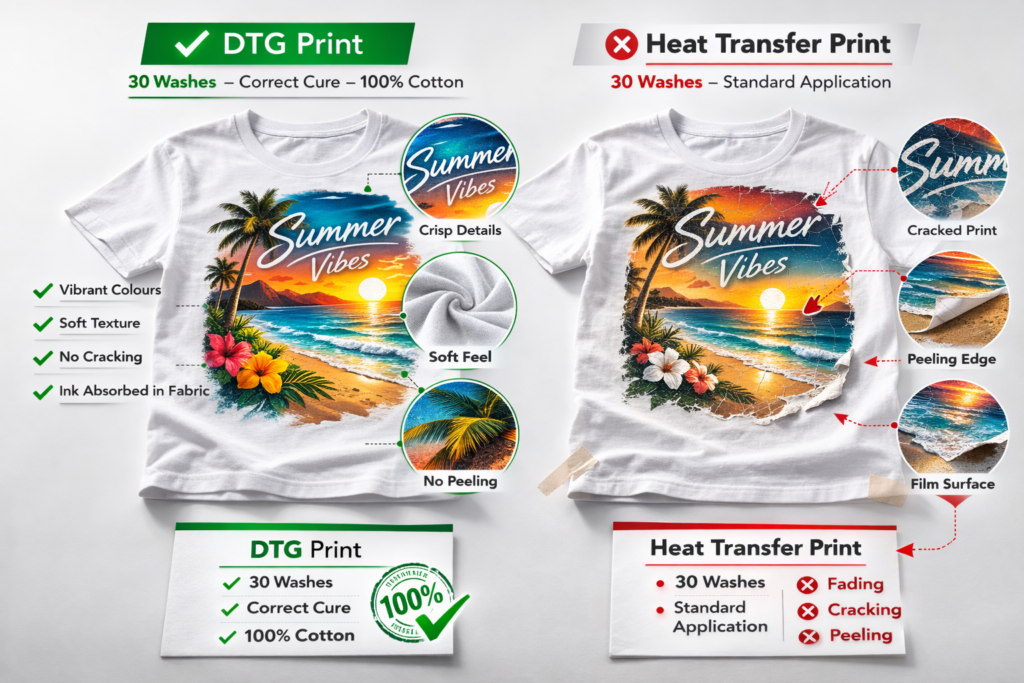
DTG printing and heat transfer printing are fundamentally different processes despite both producing printed garment results. DTG prints water-based inks directly into fabric fibres using an inkjet printing head — the result is a soft, breathable, wash-durable print that feels like part of the garment. Heat transfer printing applies a pre-printed transfer film to the garment surface using heat and pressure — the result is a surface-sitting film layer that can feel stiffer, is more prone to peeling and cracking in heat and after washing, and generally has lower durability than a correctly produced DTG print. For personalised gifts in the GCC market, DTG is the meaningfully superior method for quality and longevity compared to standard heat transfer printing.
Q7. Will DTG printed colours fade under the Gulf sun?
All printed fabrics experience some colour fading under sustained UV exposure — this is true of every print method globally, and the effect is accelerated by the extreme UV Index levels (regularly 10–12) experienced across the Gulf region. DTG prints on dark garments are additionally susceptible to white underbase yellowing under prolonged sun exposure. The most effective steps to preserve DTG colour vibrancy are washing inside-out, drying in shade rather than direct sunlight, and storing garments away from sun-facing windows. For gifts intended for very heavy outdoor use, request that your supplier uses premium pigment inks with UV-stabiliser formulations where available.
Q8. How many pieces can I order with DTG printing for a small occasion or event?
DTG printing has no minimum and no practical maximum for small occasion orders — it is optimised for the one to fifty piece range that most individual gift buyers and occasion planners need. Baby shower favour bags for fifteen guests, matching t-shirts for eight bridesmaids, personalised tote bags for twenty birthday party attendees, family Eid matching sets for six family members — all are natural DTG order sizes. For quantities above approximately fifty pieces of the same design, discuss with your supplier whether screen printing offers a more cost-effective per-unit price, as screen printing’s setup cost is spread across larger quantities.
Q9. What fabric is best for DTG printed gifts in the UAE?
100% cotton is the optimal fabric for DTG printing — inks bond most effectively with natural cotton fibres, producing the most vibrant colours, softest hand-feel, and best wash durability. For the UAE climate specifically, 100% cotton also offers the best breathability for wearable gifts worn in high temperatures. Cotton-polyester blends with a minimum of 80% cotton are acceptable for DTG with slightly reduced vibrancy and durability. High-polyester fabrics — below 50% cotton content — are not recommended for DTG printing as ink adhesion, colour vibrancy, and wash durability are significantly compromised. For polyester sportswear gifts, sublimation printing is the appropriate alternative.
Q10. How long does DTG printing take for a personalised gift order in Dubai?
Standard DTG gift orders from reputable suppliers in Dubai typically require three to seven working days from artwork approval to delivery — significantly faster than screen printing for equivalent small quantities, as there is no screen setup or colour mixing process. Rush orders of one to five pieces may be available in one to two working days at some suppliers, subject to capacity. During peak gifting seasons — Eid, UAE National Day, graduation season, Valentine’s Day — lead times extend and capacity fills quickly at quality suppliers. Order a minimum of two weeks in advance for occasion-specific gifts during these peak periods to ensure availability and quality production without time pressure.
Industry References
Epson SureColor DTG Technical Documentation & Ink Performance Guides https://www.epson.com/en_US/products/printers/professional-imaging/dtg-printers
Brother GTX Series — DTG Printing Technical Resources & Ink Specifications https://www.brother-usa.com/products/garment-printers
Kornit Digital — Industrial DTG Ink & Wash Durability Technical Documentation https://www.kornit.com/resources
PRINTING United Alliance — DTG Printing Industry Standards & Best Practices https://www.printing.org/dtg-printing
FESPA — Textile & Garment DTG Printing Application Guides https://www.fespa.com/en/news-media/features/direct-to-garment-printing
Ricoh Industrial Solutions — Ri Series DTG Technical Specifications https://industry.ricoh.com/en/industrialprinter/ri_series
OEKO-TEX Standard 100 — Harmful Substance Testing for Textile Inks https://www.oeko-tex.com/en/our-standards/oeko-tex-standard-100
ISO 105-C06 — Colour Fastness to Domestic and Commercial Laundering https://www.iso.org/standard/67528.html
ISO 105-B02 — Colour Fastness to Artificial Light: Xenon Arc Fading Lamp Test https://www.iso.org/standard/63359.html
Mimaki — Textile Printing & Garment Ink Application Technical Guides https://mimaki.com/product/inkjet/textile