
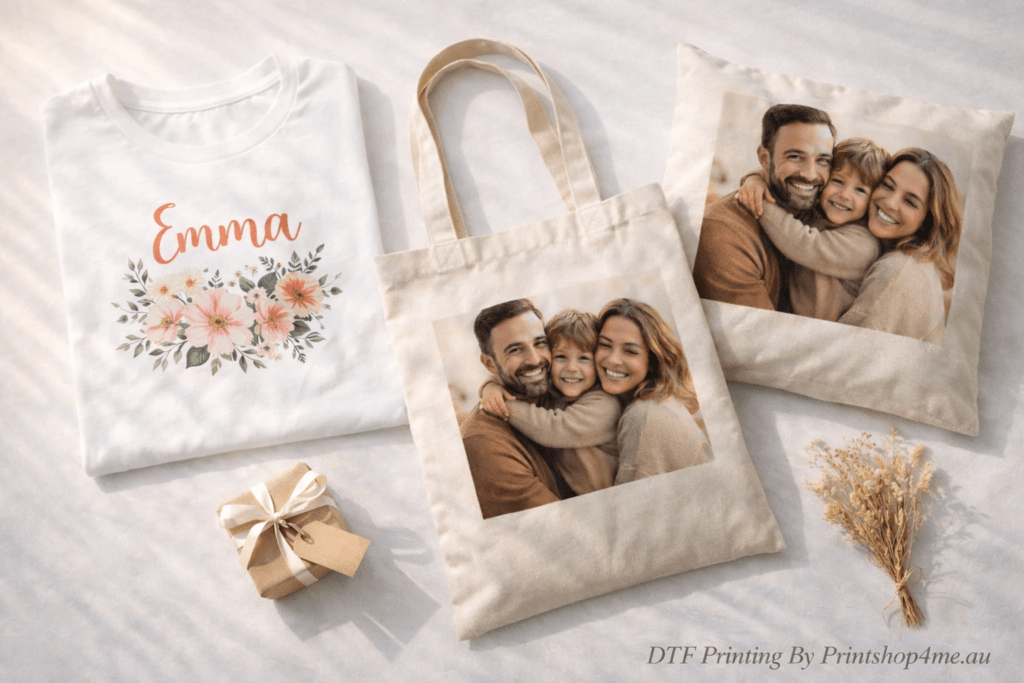
When a Gift Becomes Truly Yours
There is something special about receiving a gift that has your name on it — or a photo of a memory you treasure, or a message that only the two of you would understand.
In a world full of generic presents, personalised gifts stand apart. They say: I thought about you. I made this for you.
Across Australia and New Zealand, the demand for personalised gifts has grown enormously. Whether it is a custom t-shirt for a birthday, a photo cushion for a new mum, or a personalised tote bag for a wedding guest, people are increasingly choosing gifts that carry personal meaning.
One of the most exciting technologies behind these gifts is Direct to Film printing, commonly known as DTF printing.
If you have ever ordered a custom t-shirt or hoodie and wondered how the design looks so crisp, colourful, and detailed, DTF printing is very likely the technology behind it.
In this guide, we will explain everything you need to know about DTF printing — how it works, what kinds of personalised gifts it can create, and when it is the right printing method to choose.
What Is DTF Printing?
Direct to Film (DTF) printing is a modern digital printing method used to transfer full-colour designs onto fabric and other flexible surfaces.
Instead of printing directly onto the garment, the design is first printed onto a special transfer film.
A hot-melt adhesive powder is applied to the printed design and cured. The film is then heat-pressed onto the product, bonding the design permanently to the fabric.
The result is a vibrant, detailed print that sits smoothly on the material.
Why DTF Printing Is Popular for Personalised Gifts
DTF printing has become extremely popular because it allows complex designs to be printed quickly and affordably.
Here are some reasons people choose DTF printing for personalised gifts.
Full-Colour Designs
DTF printing handles complex artwork, photographs, and gradients very well.
This makes it ideal for designs featuring:
- photos
- colourful illustrations
- detailed graphics
Works on Many Fabrics
DTF transfers bond well to many materials including:
- cotton
- polyester
- blended fabrics
- canvas
- denim
- nylon
This versatility makes it suitable for clothing, bags, and home décor items.
No Minimum Order Quantity
DTF printing allows single personalised items to be produced easily.
This makes it perfect for one-off gifts such as a single birthday t-shirt or personalised tote bag.
Fast Production
Because the process is fully digital, designs can be printed quickly without creating screens or templates.
Durable Prints
When properly applied and cared for, DTF prints remain vibrant and wash-resistant.
How DTF Printing Works
The DTF process includes several steps.
Step 1 — Design Preparation
The artwork or photo is prepared digitally.
Step 2 — Printing to Film
The design is printed onto PET transfer film using specialised DTF inks.
A white ink base layer is added so colours remain vibrant even on dark fabrics.
Step 3 — Adhesive Powder Application
Hot-melt adhesive powder is applied to the printed design.
Step 4 — Curing
The adhesive powder is heated and cured to prepare the transfer.
Step 5 — Heat Press
The film is pressed onto the garment using heat and pressure.
Step 6 — Film Removal
The transfer film is peeled away, leaving the design bonded to the fabric.
Personalised Gifts Made with DTF Printing
DTF printing can be used to create a wide range of personalised gifts.
Custom T-Shirts
Custom t-shirts are the most common DTF printed product.
Popular occasions include birthdays, family reunions, and holidays.
Personalised Tote Bags
Custom tote bags printed with names or quotes make practical and thoughtful gifts.
Cushion Covers
Printed cushion covers featuring photos or artwork are popular home décor gifts.
Graduation Gifts
Personalised hoodies, bags, and apparel are popular graduation presents.
Wedding Gifts
Matching apparel or personalised accessories can be created for weddings and bridal parties.
Baby Gifts
Baby onesies and children’s clothing can be personalised with names or designs.
What DTF Printing Does Well
DTF printing excels in several areas.
Complex Designs
DTF handles detailed artwork and multi-colour graphics extremely well.
Dark Fabric Printing
Because of the white ink layer, DTF works well on dark fabrics.
Fine Detail
Small text and intricate designs can be reproduced clearly.
Fabric Compatibility
DTF printing works on many types of fabrics.
Single Item Production
One-off personalised gifts can be produced without large setup costs.
Limitations of DTF Printing
DTF printing also has some limitations.
Not Suitable for Hard Surfaces
DTF cannot be applied directly to items such as:
- ceramic mugs
- glass
- metal plaques
- wooden boards
These products use other methods such as sublimation or engraving.
No Raised Texture
DTF prints lie flat on the fabric and cannot create an embroidered or raised effect.
Stretchy Fabrics
Highly elastic fabrics may cause prints to crack if stretched excessively.
Outdoor Applications
DTF prints are designed for clothing and indoor products rather than permanent outdoor display.
Slight Texture
Large DTF prints may have a slightly noticeable texture on the fabric surface.
DTF Printing Pros and Cons
| Pros | Cons |
|---|---|
| Excellent full-colour printing | Not suitable for hard surfaces |
| Works on dark fabrics | Slight texture on fabric |
| Wide fabric compatibility | Not ideal for very stretchy materials |
| Single item orders possible | Not intended for outdoor signage |
| Fast production | Raised effects not possible |
Durability in Australian and New Zealand Conditions
Australia and New Zealand experience varying climates including strong sunlight and humidity.
DTF prints perform well when garments are used and cared for normally.
Heat
DTF prints are heat-pressed during production, which helps the design bond to the fabric.
Sunlight
Long periods of direct sunlight may gradually cause fading, as with most printed fabrics.
Humidity
Normal humidity levels do not affect DTF prints when garments are stored properly.
DTF vs Other Printing Methods
| Printing Method | Heat Resistance | UV Resistance | Best Use |
|---|---|---|---|
| DTF Printing | Good | Moderate | Fabric gifts and clothing |
| Sublimation Printing | Good | Good | Polyester items and mugs |
| Laser Engraving | Excellent | Excellent | Wood, metal, acrylic gifts |
| Embroidery | Excellent | Excellent | Apparel and caps |
Tips to Make DTF Prints Last Longer
To maximise the lifespan of your personalised gift:
- wash garments inside out
- use cold or warm water
- avoid bleach or harsh detergents
- air dry or tumble dry on low heat
- avoid ironing directly on the print
Frequently Asked Questions
Can I order just one personalised item?
Yes. DTF printing allows single custom items with no minimum order.
Will the design fade in sunlight?
Under normal use and proper care, DTF prints remain vibrant for a long time.
Can I upload my own design?
Yes. Most personalised gifts allow you to upload photos or artwork.
How long does delivery take?
Typical timelines:
Production: 1–3 business days
Australia delivery: 2–5 business days
New Zealand delivery: 3–6 business days
Is DTF printing safe for children’s clothing?
Yes. Once cured, DTF inks are safe for garments including children’s clothing.